Dr. Alexia Briassouli is an Assistant Professor on Artificial intelligence, Computer Vision for e-health, as well as multi-modal AI, at the University of Twente since Sept 2023. Her research focuses on issues related to generalizability, robustness of AI, but also the development and integration of AI solutions to applications related to e-health, such as sports. AI for medical images means that MRIs, CT scans, Xrays, PET scans and more are automatically analyzed to find, for example, a tumor or a broken bone. They can also be analyzed to predict the progression of a disease, in many cases integrating multi-modal data.
Alexia received her Ph.D. from the Department of Electrical and Computer Engineering at the University of Illinois in Urbana Champaign in 2006. She also has a master’s degree from the interdisciplinary program for Systems of Signal Processing and Communications, Theory and Application at the Univ. of Patras (2000), while her diploma is on Electrical and Computer Engineering at the National Technical Univ. of Athens in 1999. She has taught at Univ of Maastricht and Univ of Patras as well as Univ of Twente. She also worked at the Information Technologies Instistute at the Centre for Research and Technology, Hellas (CERTH-ITI) in Thessaloniki, Greece from 2007-2017, where she coordinated and participated in European and National funding proposals and projects, supervised PhDs and research for EU projects. Alexia is also a reviewer for European proposals since 2007, as well as NWO Vini and ENW proposals.
Organisations
Alexia's research is in the field of Artificial Intelligence, with a focus on Computer Vision and multi-modal data analysis for e-health. In medical and in general health-related applications, the correct detection/prediction and low rate of false alarms are of critical importance, and can prove lifesaving. Moreover, trust in such systems is important for their reliable deplyment in the real world.
Her current research interests examine the important issues of generalizability, robustness of AI for medical images and multi-modal health data overall. State-of-the-Art methods often face difficulties analyzing data with a distribution shift from the data they were trained on: her work is examining how these issues can be resolved. Explainability is also central, for developing methods that are trustworthy, and also tracing back errors when they occur.
- 2001 – 2005
- PhD Electrical and Computer Engineering University of Illinois at Urbana-Champaign (USA) Department of Electrical and Computer Engineering PhD Thesis: Fusion of Frequency and Spatial Domain Information for Motion Analysis Thesis advisor: Prof. Narendra Ahuja
- 1999 – 2001
- M.Sc. Signal and Image Processing Systems University of Patras (Greece) Interdepartmental Program "Signal and Image Processing Systems: Theory, Implementations, Applications (SIPS)" M.Sc. Thesis: Hidden Messages in Heavy-Tails: DCT-Domain Watermark Detection Using Alpha-Stable Models Thesis advisor: Prof. Panagiotis Tsakalides.
- 1994 – 1999
- Diploma Electrical and Computer Engineering National Technical University of Athens (Greece) Department of Electrical and Computer Engineering Thesis: Improving the 3D Reconstruction of Images from 2D Sequences of Video Frames in the Presence of Additive Noise Thesis advisor: Prof. S. Kollias.
Courses academic year 2026/2027
Courses in the current academic year are added at the moment they are finalised in the Osiris system. Therefore it is possible that the list is not yet complete for the whole academic year.
Courses academic year 2025/2026
- MindSpaces: Art-driven Adaptive Indoors and Outdoors Design
H2020 EU project
https://mindspaces.eu/- The central objective of MindSpaces is to create the tools and develop the solutions for adaptive and inclusive spaces that dynamically adapt to emotional, aesthetical and societal responses of end users, creating functionally and emotionally appealing architectural design. Artists and technology experts closely collaborate to propose innovative designs that address societal challenges faced by cities as they expand, and the evolving needs in functionality and emotional resonance of modern day workplace and housing interiors. State-of-the-Art (SoA) multisensing technology, such as wearable EEG, physiological sensing, visual analysis, social media inputs, will be integrated for the immediate assessment of innate user responses to the MindSpaces installations, and artistic adaptation of the designs accordingly.
- Dem@Care: Dementia Ambient Care Multi-Sensing Monitoring for Intelligent Remote Management and Decision Support
FP7 EU project
https://demcare.eu/- Dem@Care aspires to contribute to the timely diagnosis, assessment, maintenance and promotion of self-independence of people with dementia, by deepening the understanding of how the disease affects their everyday life and behaviour. It implements a multi-parametric closed-loop remote management solution that affords adaptive feedback to the person with dementia, while at the same time including clinicians into the remote follow-up, enabling them to maintain a comprehensive view of the health status and progress of the affected person.
- Dem@Care aspires to contribute to the timely diagnosis, assessment, maintenance and promotion of self-independence of people with dementia, by deepening the understanding of how the disease affects their everyday life and behaviour. It implements a multi-parametric closed-loop remote management solution that affords adaptive feedback to the person with dementia, while at the same time including clinicians into the remote follow-up, enabling them to maintain a comprehensive view of the health status and progress of the affected person.
- The system includes: a loop for people with dementia and their informal caregivers to monitor and assess their cognitive and behavioural status by integrating a multiplicity of wearable and in-situ sensors, enable time evolving context-sensitive profiling to support reactive and proactive care, and afford personalised and adaptive feedback. a loop for dementia clinicians to provide objective observations regarding the health progression of the person with dementia and medication effectiveness, warn about trends closely related to dementia (e.g. apathy), and support preventive care decision making and adjustment of treatment recommendations.
Address
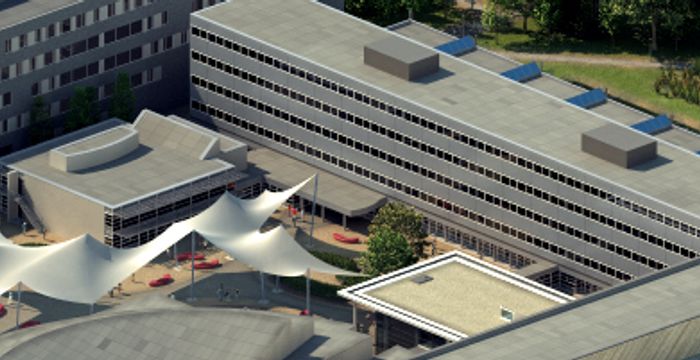
University of Twente
Zilverling (building no. 11), room 4049
Hallenweg 19
7522 NH Enschede
Netherlands
University of Twente
Zilverling 4049
P.O. Box 217
7500 AE Enschede
Netherlands
 Scan the QR code or