Alireza is a Ph.D. candidate at the Faculty of Engineering Technology, Chair of Nonlinear Solid Mechanics (NSM), at the University of Twente. He is currently working on material constitutive modeling using machine learning methods. His current research is funded by the DEPMAT (Data-enhanced physical materials modeling) Project of the NWO.
In addition, his research interests include computational solid mechanics as well as damage and fracture mechanics.
Expertise
Engineering
- Constitutive Model
- Hardening Law
- Helmholtz Free Energy
- Loading Path
- One Dimensional
- Potential Energy
- Recursive
- Strain Path
Organisations
Publications
2026
2023
Research profiles
- M.Sc., Mechanical Engineering - Applied Design, Isfahan University of Technology, Isfahan, Iran (2019-2022).
- B.Sc., Mechanical Engineering, Isfahan University of Technology, Isfahan, Iran (2014-2019).
1D Stress Evolution Prediction via Thermodynamically-Informed Neural Networks
Accurate modeling of elastoplastic behavior is crucial for forming simulations, yet conventional constitutive laws require extensive calibration and often fail to generalize across diverse loading paths. To address this limitation, a thermodynamically informed neural-network framework is proposed for predicting one-dimensional stress evolution. The model integrates physical consistency into a data-driven formulation by coupling two neural components: one learns the state evolution, predicting increments of the internal variable, while the other approximates the Helmholtz free-energy potential, from which stresses are obtained via automatic differentiation. Synthetic datasets generated from randomized strain paths with power-law hardening were used for training, ensuring broad coverage of nonlinear responses. The model successfully reproduces monotonic, unloading, reverse, and random loading behaviors with minimal error accumulation and stable recursive inference. Owing to its incremental formulation, the framework maintains predictive accuracy beyond the trained strain range, offering a physically interpretable and data-efficient alternative to conventional constitutive models.
Read more at:
Address
University of Twente
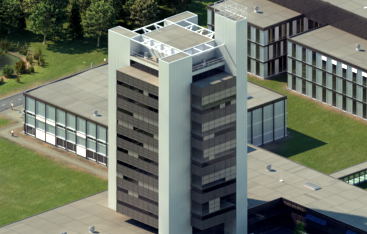
Horst Complex (building no. 20), room N127
De Horst 2
7522 LW Enschede
Netherlands
University of Twente
Horst Complex N127
P.O. Box 217
7500 AE Enschede
Netherlands
 Scan the QR code or