Researcher webpage: https://r-franchi.eu
Antonio Franchi holds a joint appointment as full professor in aerial robotics control at the University of Twente (EEMCS Faculty, RAM department), Enschede, The Netherlands, and full professor at the Sapienza University of Rome (DIAG department), Rome, Italy.
He is an IEEE Fellow.
From 2022 till 2023 he was a Full Professor at the University of Twente. From 2019 till 2021 he was an Associate Professor at the University of Twente. From 2019 till 2023 he was an Affiliated Researcher at LAAS-CNRS. From 2014 to 2019 he was a Permanent Researcher at CNRS and the leader of the aerial robotics activities at LAAS-CNRS. From 2010 to 2013 he was a Research Scientist and then a Senior Research Scientist at the Max Planck Institute for Biological Cybernetics in Germany, and the scientific leader of the group “Autonomous Robotics and Human Machine Systems”. He received the Laurea (M.Sc.) degree (summa cum laude) in Electronic Engineering and the Ph.D. degree in System Engineering (Feb. 2010) from Sapienza University of Rome, Italy. In 2009 he was a visiting student at the University of California at Santa Barbara.
He received both the French and Italian Professorial Habilitation for Full-professorship (HDR and ASN resp.) from the National Polytechnic Institute of Toulouse and the Italian Ministry of University and Research in 2016 and 2018, respectively.
Expertise
Computer Science
- Robotics
- Robot
- Unmanned Aerial Vehicle
- Manipulator
- multiple robot
Engineering
- Rotors
- Quadcopter
- Propeller
Organisations
Ancillary activities
- European CommissionEvaluator for he EU
- Sapienza University of RomeTeaching and collaboration with Sapienza University of Rome
News:
👉 08/26 Video presentation of the aerodynamic co-contraction concept: https://r-franchi.eu/dissemination/aerodyn-co-contraction.html
`Publications:
👉 https://scholar.google.com/citations?user=DqOnkE8AAAAJ&hl=en
My research is dedicated to advancing the mathematical foundations of robot modeling, identification, and control to enable safe, intelligent, and physically interactive aerial systems for society.
A recurring theme across my work is the integration of rigorous control and estimation theory with real robotic systems, especially in scenarios involving physical interaction, uncertainty, decentralization, and human presence. My contributions span theory, algorithms, system design, and experimental validation, often closing the loop between mathematical models and deployable robotic platforms.
Up to 2026, I have authored 200+ peer‑reviewed publications in international journals, books, and conferences, and delivered 100+ invited and plenary talks worldwide. My research has been recognized through awards for scientific contributions, PhD mentoring, and service to the robotics community.
I have served on the editorial boards of IJRR, IEEE T‑RO, IEEE RA‑M, IEEE ICRA, IEEE/RSJ IROS, and IEEE AES‑M, and I am a co‑founder and emeritus co‑chair of the IEEE RAS Technical Committee on Multiple Robot Systems.
Major Research Areas
1. NONLINEAR CONTROL ALLOCATION AND ACTUATION GEOMETRY
(Signed‑quadratic actuation maps, fiber geometry, aerodynamic promptness, energy efficiency)
This research line investigates nonlinear control allocation for multirotors governed by signed‑quadratic actuation maps. It studies the geometry of the fibers associated with redundant actuation and how motion along these fibers can shape properties that are not directly prescribed by the commanded wrench. These include active aerodynamic promptness, power consumption, incremental aerodynamic damping, and passive interaction behavior. The resulting framework establishes multirotors as variable‑impedance actuators whose internal actuation can be optimized to balance responsiveness, energy efficiency, and physical interaction performance.
Representative and Recent Publications
- Muscle coactivation in the sky: Geometry and Pareto optimality of energy vs. aerodynamic promptness and multirotors as variable stiffness actuators, IEEE ICUAS 2026. Best Conference Paper Award.
https://doi.org/10.1109/ICUAS69441.2026.11598607 - Variable aerodynamic damping actuation via co‑contraction: A structural analogy with variable stiffness actuation, IEEE Robotics and Automation Letters, 2026
https://doi.org/10.1109/LRA.2026.3723738 - The N-5 Scaling Law: Topological Dimensionality Reduction in the Optimal Design of Fully-actuated Multirotors, The International Journal of Robotics Research (in press), 2026
https://arxiv.org/abs/2512.23619 - Global geometry of orthogonal foliations of signed‑quadratic systems, preprint, 2026
https://arxiv.org/abs/2604.01912 - Drag-Aware Aerodynamic Manipulability for Torque-Limited Redundant Multirotors: Aerodynamic Promptness based on the Symmetric Acceleration Capacity, preprint, 2026
https://arxiv.org/abs/2603.07998
2. Aerial Robots in Physical Interaction and Manipulation
(Human–robot interaction, contact, force control, aerial manipulation)
This research line addresses the fundamental challenge of enabling aerial robots to physically interact with the environment and with humans, going well beyond free‑flight motion. It includes interaction control, compliance, force regulation, whole‑body control, and safety‑aware architectures, often validated on real aerial manipulators.
Representative and Seminal Publications
- Past, present, and future of aerial robotic manipulators, IEEE Transactions on Robotics, 2021
https://doi.org/10.1109/TRO.2021.3084395 - The flying end‑effector paradigm, The International Journal of Robotics Research, 2019
https://doi.org/10.1177/0278364919856694 - Aerial physical interaction via IDA‑PBC, The International Journal of Robotics Research, 2019
https://doi.org/10.1177/0278364919835605 - Energy‑aware impedance control of a flying end‑effector, IEEE Transactions on Robotics, 2022
https://doi.org/10.1109/TRO.2022.3183532 - Predictive admittance control for aerial physical interaction, IEEE Robotics and Automation Letters, 2025
https://doi.org/10.1109/LRA.2025.3608653 - Whole‑body teleoperation and shared control of aerial manipulators, Journal of Intelligent & Robotic Systems, 2021
3. Cooperative Aerial Manipulation and Cable‑Suspended Systems
(Multi‑UAV manipulation, cables, internal forces, full‑pose control)
This area studies teams of aerial robots cooperatively manipulating objects, especially via cables or suspended structures. The work provides dynamic modeling, stability analysis, internal‑force regulation, and nonlinear predictive control, enabling manipulation tasks that are impossible for single robots.
Representative and Seminal Publications
- Agile and cooperative aerial manipulation of a cable‑suspended load, Science Robotics, 2025
https://doi.org/10.1126/scirobotics.adu8015 - Aerial robots carrying flexible cables, IEEE Transactions on Robotics, 2025
https://doi.org/10.1109/TRO.2025.3562459 - Full‑pose manipulation of cable‑suspended loads with multiple UAVs, IEEE Robotics and Automation Letters, 2020
https://doi.org/10.1109/LRA.2020.2969930 - Equilibria, stability, and sensitivity of aerial suspended systems, IEEE Transactions on Robotics, 2023
https://doi.org/10.1109/TRO.2023.3279033 - Control and motion of tethered aerial robots, IEEE Transactions on Robotics, 2017
https://doi.org/10.1109/TRO.2017.2687057 - Theory and Applications for Control of Aerial Robots Through Tethers (Book), Springer, 2020
https://doi.org/10.1007/978-3-030-48659-4
4. Morphing, Fully‑Actuated, and Fault‑Tolerant Aerial Platforms
(Design, actuation taxonomy, redundancy, resilience)
This research line develops new classes of aerial vehicles with omnidirectional thrust, morphing geometries, and actuation redundancy, enabling capabilities such as hovering under failures, full‑pose control, and interaction robustness. Contributions span theory, optimal design, and experimental platforms.
Representative and Seminal Publications
- Fundamental actuation properties of multi‑rotors, IEEE Transactions on Robotics, 2018
https://doi.org/10.1109/TRO.2018.2821155 - Design of multirotor aerial vehicles: A taxonomy based on input allocation, The International Journal of Robotics Research, 2021
https://doi.org/10.1177/02783649211025998 - FAST‑Hex: A morphing hexarotor, IEEE/ASME Transactions on Mechatronics, 2021
https://doi.org/10.1109/TMECH.2021.3099197 - A novel robust hexarotor capable of hovering under propeller failure, IEEE Robotics and Automation Letters, 2021
https://doi.org/10.1109/LRA.2021.3067182 - Omnidirectional aerial vehicles with unidirectional thrusters, IEEE Robotics and Automation Letters, 2018
https://doi.org/10.1109/LRA.2018.2802544
5. Geometric and Nonlinear Control of Robotic Systems
(Manifold‑based control, underactuation, nonlinear MPC)
Here, I develop coordinate‑free control and estimation methods for nonlinear robotic systems evolving on manifolds such as SO(3), SE(3), and product spaces. This includes feedback linearization extensions, sensitivity‑aware planning, and nonlinear MPC, with applications well beyond aerial robotics.
Representative and Seminal Publications
- Unified feedback linearization for nonlinear systems, IEEE Control Systems Letters, 2025
https://doi.org/10.1109/LCSYS.2025.3549999 - Input–output extension of underactuated nonlinear systems, IEEE Control Systems Letters, 2025
https://doi.org/10.1109/LCSYS.2025.3601657 - Sensitivity‑aware trajectory planning, IEEE Robotics and Automation Letters, 2024
https://doi.org/10.1109/LRA.2024.3468088 - Hierarchical nonlinear control based on zero‑moment direction, Automatica, 2020
https://doi.org/10.1016/j.automatica.2020.108991 - Full‑pose trajectory tracking with bounded lateral force, IEEE Transactions on Robotics, 2018
https://doi.org/10.1109/TRO.2017.2786734
6. Multi‑Robot Systems: Coordination, Estimation, and Connectivity
(Decentralized control, rigidity theory, formations, localization)
This long‑standing research line investigates cooperation in multi‑robot systems under limited communication and sensing, including distributed estimation, rigidity‑based formation control, leader selection, and connectivity maintenance.
Representative and Seminal Publications
- Rigidity maintenance control for multi‑robot systems, Robotics: Science and Systems, 2012
- Distributed estimation in cooperative manipulation, IEEE Transactions on Control of Network Systems, 2019
https://doi.org/10.1109/TCNS.2018.2873153 - Online leader selection for collective tracking, IEEE Transactions on Control of Network Systems, 2018–2019
https://doi.org/10.1109/TCNS.2016.2567222 - Mutual localization in multi‑robot systems, The International Journal of Robotics Research, 2013
https://doi.org/10.1177/0278364913483835 - Decentralized encirclement with collision avoidance, Autonomous Robots, 2016
7. Human–Robot Interaction, Teleoperation, and Shared Control
(Haptics, shared autonomy, safety)
This research area focuses on human‑in‑the‑loop robotic systems, particularly for teleoperation, shared control, and physical collaboration with aerial and mobile robots. The work combines passivity‑based control, haptic feedback, and safety guarantees.
Representative and Seminal Publications
- Shared control: balancing autonomy and human assistance, IEEE Robotics & Automation Magazine, 2012
https://doi.org/10.1109/MRA.2012.2205657 - Mixed‑initiative control for safe human–quadrotor interaction, IEEE Robotics and Automation Letters, 2021
https://doi.org/10.1109/LRA.2021.3096502 - Bilateral teleoperation of multiple UAVs, IEEE Transactions on Robotics, 2012
https://doi.org/10.1109/TRO.2012.2200460 - Human‑centered design of haptic cueing, IEEE Transactions on Systems, Man, and Cybernetics, 2013
Research at the Intersection of Theory and Impact
Across all these areas, my research philosophy is to develop theoretically principled methods that matter in practice, validated through real experiments, open platforms, and international collaborations, including large‑scale European projects such as AEROARMS, Aerial‑CORE, and AutoAssess.
Publications
Jump to: Article | Conference contribution | Letter
Article
Conference contribution
Letter
Research profiles
Courses AT the university of TWENTE:
- Control Engineering (UT Bachelor) from 2020-21 until today
- Aerial Robotics (UT, Master) from 2024-25 until today (jointly with C. Gabellieri)
- Module 6 Systems and control coordinator (UT Bachelor) from 2023-24 until today
- Lab Project on Systems and Control (UT Bachelor) from 2023-24 until today
- Control of UAVs (UT, Master) from 2020-21 until 2023-24 (jointly with C. Gabellieri)
Mentoring
I have extensive experience in the supervision and mentoring of PhD candidates, postdoctoral researchers, research engineers, and graduate students, within international and interdisciplinary research environments.
Overview
- 16 graduated PhD students
- 8 currently supervised PhD candidates
- 16 supervised postdoctoral researchers and research engineers
- 25+ visiting or externally enrolled PhD students hosted or informally advised
- More than 150 Master‑level student projects supervised
PhD Supervision
Graduated PhD Students
- Paolo Stegagno (2011)
Mutual localization from anonymous measurements in multi‑robot systems
Sapienza University of Rome — Co‑advisor: G. Oriolo - Carlo Masone (2014)
Planning and Control for Robotic Tasks with a Human‑in‑the‑Loop
University of Stuttgart — Co‑advisors: F. Allgöwer, H. H. Bülthoff, P. Robuffo Giordano, C. Secchi - Antonio Petitti (2015)
Theory and Applications of Consensus Protocols for Distributed Estimation Algorithms
Polytechnic of Bari — Co‑advisors: A. Rizzo, D. di Paola - Burak Yüksel (2016)
Design, Modeling and Control of Aerial Robots for Physical Interaction and Manipulation
University of Stuttgart — Co‑advisors: F. Allgöwer, H. H. Bülthoff - Nicolas Staub (2017)
Models, Algorithms and Architectures for Cooperative Manipulation with Aerial and Ground Robots
Université Toulouse III – Paul Sabatier / LAAS‑CNRS - Marco Tognon (2018)
Theory and Applications for Control and Motion Planning of Aerial Robots in Physical Interaction (focus on tethered aerial vehicles)
INSA Toulouse / LAAS‑CNRS — Co‑advisor: J. Cortés - Victor Arrelliano (2019)
Design Optimization of Multirotors Using Evolutionary Algorithms
IPN, Mexico City — Co‑advisor: E. A. Merchán Cruz - Quentin Delamare (2019)
Algorithms for estimation and control for quadrotors in physical interaction with the environment
University of Rennes / IRISA — Co‑advisor: P. Robuffo Giordano - Davide Bicego (2019)
Design and Control of Multi‑Directional Thrust Multi‑Rotor Aerial Vehicles with Applications to Aerial Physical Interaction Tasks
INSA Toulouse / LAAS‑CNRS - Mahmoud Hamandi (2021)
Effect of Actuation Properties of Multi‑Rotor Aerial Vehicles on Their Abilities: Emphasis on Hoverability, Failure Robustness and Trajectory Tracking
INSA Toulouse / LAAS‑CNRS - Dario Sanalitro (2022)
Aerial Cooperative Manipulation: Full‑pose Manipulation in Air and in Interaction with the Environment
INSA Toulouse / LAAS‑CNRS - Martin Jacquet (2022)
Methods for Online Predictive Control of Multirotor Aerial Robots with Perception‑driven Tasks subject to Sensing and Actuation Constraints
INSA Toulouse / LAAS‑CNRS - Gianluca Corsini (2023)
Control Methods for Aerial Robotic Systems in Physical Interaction with Humans
Université Toulouse III – Paul Sabatier / LAAS‑CNRS — Co‑advisor: D. Sidobre - A. Coelho (2024)
Whole‑body Control and Teleoperation of a Suspended Aerial Manipulator
University of Twente — Co‑advisors: C. Ott, K. Kondak - A. Srour (2024)
Robust Planning for Robotic Systems
University of Rennes — Co‑advisors: P. Robuffo Giordano, M. Cognetti - A. Afifi (2025)
Optimization‑based Methods for Safe & Robust Aerial Robots
University of Twente — Co‑advisor: P. Robuffo Giordano
Current PhD Candidates
- A. Rapuano (2025–ongoing) — Modeling and control of flexible systems
- S. Orelli (2025–ongoing) — Control of underactuated systems
- A. Ali (2023–ongoing) — Control of aerial robotic systems — Co‑supervisor: C. Gabellieri
- M. Mizzoni (2023–ongoing) — Design and control of aerial robotic arms — Co‑supervisor: A. Afifi
- A. Alharbat (2022–ongoing) — Optimization‑based control of aerial robots — Co‑supervisors: A. Mersha, C. Gabellieri
- Y. Shen (2022–ongoing) — Aerial manipulation of deformable objects — Co‑supervisor: C. Gabellieri
- H. Esmaeeli (2021–ongoing) — Aerial inspection by contact — Co‑supervisors: A. Mersha, S. Stramigioli
- Y. Aboudorra (2020–ongoing) — Multirotor control and aerodynamics — Co‑supervisor: C. Gabellieri
Postdoctoral Researchers (Complete)
- B. Bazzana (2023–ongoing) — GNSS‑denied navigation — University of Twente
- A. Afifi (2025) — Aerial Physical Inspection — University of Twente
- P. van Goor (2024–2025) — Geometric Estimation and Control — University of Twente
- S. Sun (2022–2023) — Robust Control for Aerial Systems — University of Twente
- C. Gabellieri (2021–2023) — Deformable Aerial Manipulation — University of Twente
- D. Bicego (2020–2022) — Aerial Co‑workers — University of Twente
- A‑E. Jimenez Cano (2019–2022) — Outdoor Aerial Robotics — LAAS‑CNRS
- H. Savino (2019–2020) — Cooperative Manipulation — LAAS‑CNRS
- M. Tognon (2018–2020) — Heterogeneous Cooperative Robots — LAAS‑CNRS
- M. Furci (2016–2017) — Aerial Robots with Input Saturation — LAAS‑CNRS
- M. Ryll (2014–2017) — Aerial Robot Design and Control — LAAS‑CNRS
- P. Stegagno (2013) — Vision‑based navigation with aerial robots — Max Planck Institute for Biological Cybernetics (MPI‑KYB)
Research Engineers (Complete)
- Q. Sable (2017–ongoing) — Design of ultra‑lightweight manipulators
- H. Das (2020–2022) — Software for aerial manipulation
- H. Tello‑Chavez (2017) — Motion planning for aerial manipulators
Visiting & Collaborating PhD Students (Complete)
- Matt Hampsey (2024–ongoing) — Australian National University
- Tong Hui (2024) — Danish Technical University
- Shima Akbari (2024) — University of Tor Vergata
- Frederik Falk Nyboe (2024) — University of Southern Denmark
- Antonio Gonzalez Morgado (2024–2025) — University of Seville
- Filip Zoric (2023–ongoing) — University of Zagreb
- Viktor Walter (2017–2024) — Czech Technical University
- Barbara Barros (2019–2022) — Real‑Time Nonlinear Model Predictive Control for Motion Generation in Robotic Systems(2022) — Sapienza University of Rome
- Chiara Gabellieri (2017–2021) — The Role of Interaction Forces in Robotic Manipulation for Logistics: A Special Focus on Depalletizing and Object Delivery (2021) — University of Pisa
- Enrica Rossi (2019–2020) — Distributed MPC over wireless for robotic manipulation (2020) — University of Padua
- Enrico Ferrentino (2019–2020) — Dynamic Programming for Optimal Planning and Control of Redundant Robot Manipulators(2020) — University of Salerno
- Gabriele Nava (2019–2020) — Instantaneous Momentum‑Based Control of Floating Base Systems (2020) — University of Genova / IIT
- Giuseppe Silano (2019–2020) — Software‑in‑the‑loop methodologies for the analysis and control design of small UAV systems(2020) — University of Sannio
- Mattia Giurato (2019–2020) — Design, integration and control of multirotor UAV platforms (2020) — Polytechnic of Milan
- Elisabetta Cataldi (2016–2017) — Floating‑base system arm equipped: kinematic‑dynamic control and planning (2017) — University of Cassino
- Giulia Michieletto (2015–2017) — Multi‑Agent Systems in Smart Environments (2017) — University of Padua
- Mostafa Mohammadi (2015–2017) — Bilateral Aerial Tele‑Manipulation: Single and Multi‑Robot Approaches (2017) — University of Siena
- José‑Luis Sánchez López (2015–2016) — A General Architecture for Autonomous Navigation of Unmanned Aerial Systems(2017) — Polytechnic University of Madrid
- Sujit Rajappa (2013–2017) — Towards Human‑UAV Physical Interaction and Fully Actuated Aerial Vehicles (2017) — University of Tübingen
- Sara Spedicato (2013–2015) — Robust Tracking Control for Aerial Robots — University of Salento
Master‑Level Student Projects
Supervision of over 150 Master’s thesis projects at the University of Twente, Sapienza University of Rome, and partner institutions, mainly in aerial robotics, perception, control, planning, and multi‑robot systems.
Affiliated study programs
Courses academic year 2026/2027
Courses in the current academic year are added at the moment they are finalised in the Osiris system. Therefore it is possible that the list is not yet complete for the whole academic year.
Courses academic year 2025/2026
I have been involved as principal investigator, coordinator, or partner in several internationally funded research and innovation projects, supported mainly by European Union (EU), ANR (France), and NWO (The Netherlands). These projects address fundamental and applied challenges in aerial robotics, physical interaction, geometric control, and autonomous systems.
Funding refers to competitively awarded research or innovation programs that support scientific activities, personnel, and infrastructure.
Projects denote the concrete research efforts carried out within those funding frameworks, often involving international academic and industrial consortia.
As per 2025 overall, I have contributed to research and innovation projects with a combined total funding in excess of €35 million, supported by major European and national funding agencies including the European Union (FP7, H2020, Horizon Europe), ANR (France), and NWO (The Netherlands).
Major International and National Research Projects
(EU, ANR, NWO)
- AVIATOR (2023–2027)
OTP Project — NWO (NL)
Role: Principal Co-Investigator
Focus: Advanced aerial robotics and autonomous interaction capabilities. - AutoAssess (2023–2027)
Horizon Europe (EU)
Role: Principal Investigator (University of Twente)
Focus: Autonomous aerial inspection and assessment of infrastructure. - CAMP (2020–2024)
ANR – Agence Nationale de la Recherche (FR)
Role: Originator / Participant
Focus: Cooperative aerial manipulation and perception. - Aerial‑CORE (2019–2023)
Horizon 2020 (EU)
Role: Principal Investigator (University of Twente)
Focus: Core technologies for aerial robotics and physical interaction. - MuRoPhen (2017–2021)
ANR JCJC – Young Researcher Project (FR)
Role: Coordinator
Focus: Morphing and reconfigurable aerial robotic systems. - The Flying Co‑worker (2019–2022)
ANR (FR)
Role: Originator and Principal Investigator
Focus: Human–robot collaboration with aerial robots. - AeRoArms (2015–2019)
Horizon 2020 (EU)
Role: Principal Investigator (LAAS‑CNRS)
Focus: Aerial robotic manipulation with multi‑arm platforms. - PRO‑ACT (2019–2021)
Horizon 2020 (EU)
Role: Participant
Focus: Proactive collaboration between humans and robots. - FIRE‑RS (2016–2019)
Interreg SUDOE (EU)
Role: Collaborator
Focus: Robotics for firefighting and rescue operations. - ARCAS (2014–2015)
FP7 (EU)
Role: Participant
Focus: Aerial robotics for assembly and construction.
Technology Transfer, Competitive Programs, and Structured Grants
Regional, industrial, EU mobility, and structured doctoral/postdoctoral programs, supporting technology transfer, competitions, and researcher training:
- Fly‑Crane (2019) — Technology transfer project, Region Occitanie (FR)
Role: Co‑coordinator - MBZIRC Competition Team – LAAS‑CNRS
Role: Coordinator - KUKA Innovation Award Project – Tele‑MAGMaS
Role: Coordinator - Marie Curie Individual Fellowship – TRaVERSE
FP7 PEOPLE (EU)
Role: Postdoctoral Fellow - Research Training Group: Vision‑based Flying Robots
University of Tübingen (DE)
Role: Researcher - Doctoral Grants – École Doctorale Systèmes
Role: Supervisor / Coordinator
Fellowships, Mobility, and Seed Projects
Individual fellowships, mobility grants, and exploratory projects supporting international collaboration and early‑stage research:
- Carnot Institute Postdoctoral Funding
- DFG Research Fellowship (DE)
- NSF Collaborative Project (USA)
- Eiffel Excellence Fellowship Programme (multiple editions)
- University of Toulouse “Nouveaux Entrants” Programme
- Inter‑Polytechnical School PhD Mobility Grant (IT)
Current projects
EU H2020 Aerial-CORE (2019-2023)
Local Coordinator for the University of Twente
The Aerial-CORE project aims at developing novel aerial manipulating robotics technologies for the inspection and maintenance of infrastructures in strict collaboration with human workers.
ANR JCJC MuRoPhen (2018-2022)
Coordinator
The objective of this research project is to deeply investigate the problem of monitoring a dynamic phenomenon using a team of multiple mobile robots. The sensor-equipped robots will have the task of tracking and registering the phenomenon, and storing its evolution through a stream of data. In the system we envision, the robots will mutually localize themselves, autonomously control their own motion, and cooperatively perform the task at hand in an effective, reliable and safe manner.
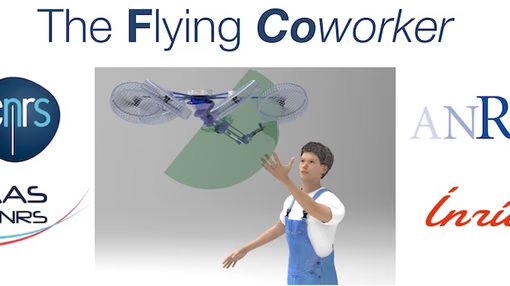
ANR The Flying Coworker (2019-2022)
Ideator and Principal Investigator
The goal of the Flying Co-Worker project is to extend the capabilities of aerial manipulators and make them able to physically interact with human workers a active in elevated places. We investigate this problem at three levels:
- mechatronics design,
- safe, robust, and predictive control and perception algorithms
- human-robot interaction and collaboration.
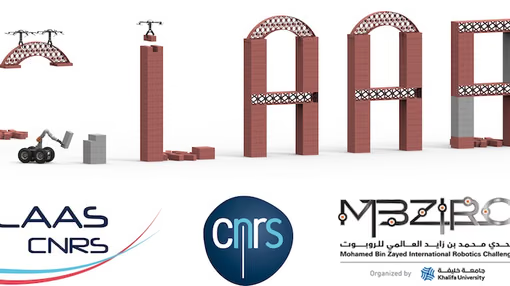
LAAS-CNRS MBZIRC 2020 (2018-2020)
Coordinator
The goal of this project is inspired by applications related to construction. In this project, a heterogeneous team of UAVs and Unmanned Ground Vehicles (UGVs) have to cooperatively build a pre-defined structure based on different types of brick-shaped objects that have to be autonomously located, picked, transported and assembled.
FlyCrane (2019-2020)
Co-coordinator
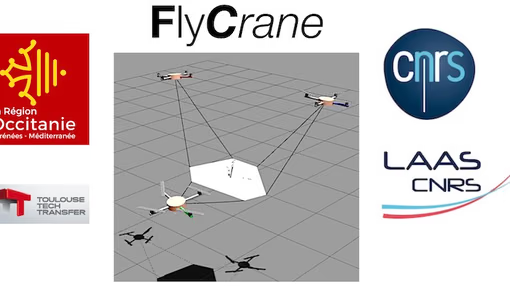
The goal of this project is join parallel/cable-driven robots and aerial robots with the conception, development and outdoor demonstration of a multi-robot aerial system capable of cooperative manipulate large objects using multiple cables.
EU H2020 AEROARMS (2015 - 2019 (4y))
Local Coordinator for LAAS-CNRS
The goal of the AeRoArms project is developing an aerial robotic system with multiple arms and advanced manipulation capabilities for application in industrial inspection and maintenance.

FIRE-RS (2016 - 2019 (3y))
Participant
FireRS (acronym for wildFIRE Remote Sensing) aims to provide to fire managers and/or coordination centers a innovative tool for early detection and wildfire management via remote sensing improving the current state-of-art.
EU H2020 ARCAS (2011-2015)
Participant
The ARCAS project proposes the development and experimental validation of the first cooperative free-flying robot system for assembly and structure construction.
Address
University of Twente
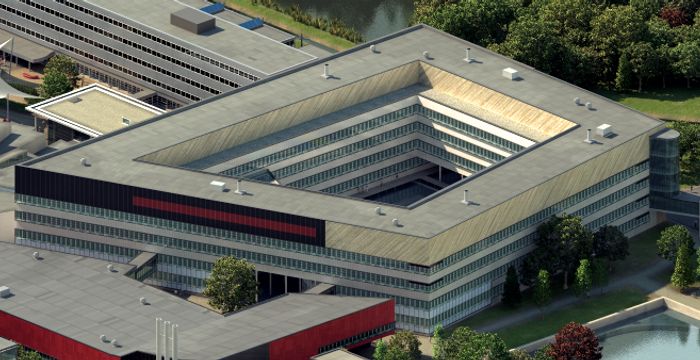
Carré (building no. 15), room C3609
Hallenweg 23
7522 NH Enschede
Netherlands
University of Twente
Carré C3609
P.O. Box 217
7500 AE Enschede
Netherlands
 Scan the QR code or