I am an Associate Professor in architected functional materials at the University of Twente. My research explores how material composition, three-dimensional architecture, and interfaces can be engineered across micro- and nanoscales to control chemical, optical, and biological functionality.
My group combines additive manufacturing, micro- and nanofabrication, electrospinning, and surface engineering to create functional metal oxides, glass and ceramic microarchitectures, structured electrodes, and responsive surfaces. We apply these materials in chemical conversion, micro-optics and photonics, sensing, and other technologies.
My current research is organized around three connected directions: 3D inorganic microarchitectures and micro-optics; structured materials for chemistry; and micro- and nanostructured interfaces for sensing and health. Across these areas, we connect material fabrication with spectroscopy, electrochemical analysis, and interface-controlled functions.
I lead and contribute to international research programmes connecting the University of Twente with academic and industrial partners in Europe and Latin America. I am WP2 leader in the EIC Pathfinder project SUN2CN, which develops solar-driven systems for converting nitrate and CO2 waste streams into value-added C-N chemicals. I am also co-founder and CTO of Encytos B.V., where structured surfaces are translated into technologies for cell-based applications.
Before joining the University of Twente, I conducted research in antimicrobial surfaces at the University of Liverpool and in plasmonic nanofabrication at Chalmers University of Technology. I received my PhD from the University of Twente for research on silicon microtechnologies for chemical sensing and electric-field-driven chemistry.
Expertise
Material Science
- Nanoparticle
- Three Dimensional Printing
- Lithography
- Zirconia
- Silicon
- Titanium Dioxide
- ZnO
- Surface-Enhanced Raman Spectroscopy
Organisations
Architected functional materials across scales
My research focuses on a central question: how can composition, geometry, and interfaces be jointly engineered to create functions that are inaccessible in conventional bulk or planar materials?
We develop architected functional materials using two- and multi-photon lithography, micro- and nanofabrication, electrospinning, thin-film deposition, and surface engineering. These methods enable control over material organization from nanoscale active sites to three-dimensional microscale architectures.
The research programme comprises three interconnected areas:
3D inorganic microarchitectures and micro-optics
We develop printable glass, ceramic, and hybrid photoresins for fabricating complex inorganic microarchitectures. Our research addresses multi-material integration, crystallization and phase control, optical activation with lanthanides, and functional micro-optics.
Structured materials for chemistry
We design structured electrodes, metal-oxide catalysts, nanofibres, and microreactors for electrocatalytic and photocatalytic transformations. Current targets include nitrate-to-ammonia conversion, coupled nitrate/CO2 conversion into C-N products, hydrogen production, CO2 reduction, and environmental remediation.
Structured interfaces for sensing and health
We investigate how micro- and nanoscale surface architecture influences sensing, bacterial attachment, cell–material interactions, and tissue-related responses. This research supports the development of structured electrodes, antibacterial interfaces, microfluidic systems, and cell-based technologies.
Across these directions, the objective is not only to fabricate smaller structures, but to understand how architecture controls transport, reactivity, light–matter interaction, and chemical/biological response.
Publications
2026
Research profiles
My educational work connects chemical and materials engineering with contemporary challenges in nanotechnology, electrochemistry, and semiconductor manufacturing. I design research-based and challenge-based learning environments in which students learn to formulate questions, evaluate evidence, construct physical models, and connect technical decisions with societal consequences.
I lead and contribute to curriculum development in systems thinking, critical thinking, inquiry and analysis, and sustainability through the CLEAR initiative in Chemical Science and Engineering. My teaching includes Sustainable Nanotechnology, Think Like a Researcher–Electrochemistry, Process Chemical Analysis, and research projects in micro- and nanofabrication.
I also develop international learning activities connecting the University of Twente with European and Latin American partners, including semiconductor education, collaborative online learning, and hands-on microfabrication experiences. My aim is to help students move confidently between fundamental understanding, experimental practice, and responsible engineering decisions.
Courses academic year 2026/2027
Courses in the current academic year are added at the moment they are finalised in the Osiris system. Therefore it is possible that the list is not yet complete for the whole academic year.
Courses academic year 2025/2026
- SUN2CN solar-driven C-N chemical production: WP2 leader in a Horizon Europe / EIC-funded project developing integrated photovoltaic–electrochemical devices to convert nitrate and CO2 waste streams into value-added C-N chemicals.
- 3D-printed inorganic micro-optics: Development of glass and ceramic microarchitectures fabricated by multi-photon lithography for micro-optics, photonics, and light–matter interaction at small scales.
- Structured materials for chemistry: Design of electrocatalytic and photocatalytic metal-oxide architectures for nitrate reduction, nitrate/CO2 conversion, water splitting, hydrogen production, and environmental remediation.
- Structured surfaces for health technologies: Development of micro- and nano-structured surfaces to control cell–material interactions, antibacterial behaviour, tissue-related responses, and microfluidic encapsulation.
- Microreactors and in situ spectroscopy: Integration of microreactor systems with spectroscopic methods to monitor catalytic reactions under controlled conditions.
Address
University of Twente
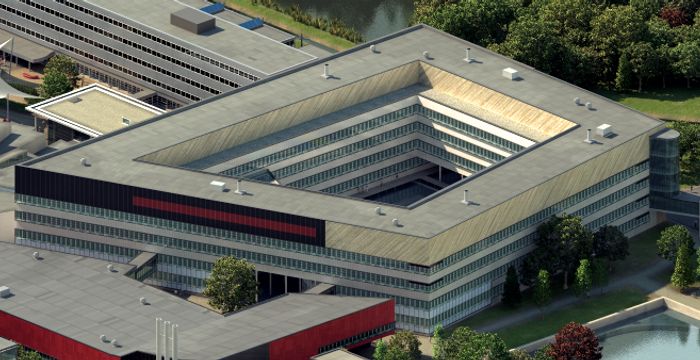
Carré (building no. 15), room C1417
Hallenweg 23
7522 NH Enschede
Netherlands
University of Twente
Carré C1417
P.O. Box 217
7500 AE Enschede
Netherlands
 Scan the QR code or