I am Guest Professor of Data Science: Statistics and Optimization at the University of Twente and Professor of Machine Learning and Optimization at the Department of Computer Science, Paderborn University, Germany. I am member of the European Research Center for Information Systems (ERCIS) and head of the ERCIS competence center Social Media Analytics as well as the ERCIS research cluster 'Data Science and AI'.

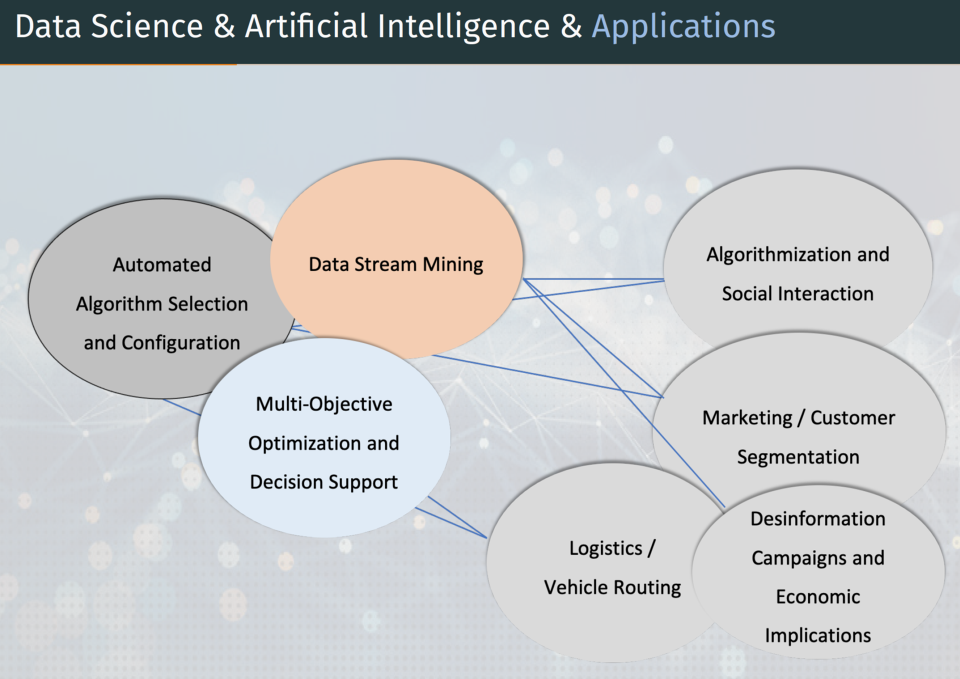
My research mainly focuses on Data Science, Data Stream Mining, Social Media Analytics, Algorithmization and Social Interaction, Automated Algorithm Selection and Configuration as well as (Multiobjective) Evolutionary Optimization. 

Expertise

  • Computer Science

    • Optimization Problem
    • Multiobjective
    • Single Objective
    • Algorithms
    • Continuous Optimization
    • Algorithm Selection
    • Social Media
    • Detection

Organisations

Ancillary activities

  • Paderborn University , GermanyProfessor of Machine Learning and Optimisation

Please have a look at my complete publication list :-)
Publications

Jump to: 2025 | 2024

2025

Multi-objective approaches for automated algorithm configuration and selection (2025)[Thesis › PhD Thesis - Research UT, graduation UT]. University of Twente. Rook, J.https://doi.org/10.3990/1.9789036567739MO-SMAC: Multiobjective Sequential Model-Based Algorithm Configuration (2025)Evolutionary Computation, 1-24 (E-pub ahead of print/First online). Rook, J. G., Benjamins, C., Bossek, J., Trautmann, H., Hoos, H. H. & Lindauer, M.https://doi.org/10.1162/evco_a_00371Deep-ELA: Deep Exploratory Landscape Analysis with Self-Supervised Pretrained Transformers for Single- and Multi-Objective Continuous Optimization Problems (2025)Evolutionary Computation, 1-27 (E-pub ahead of print/First online). Seiler, M. V., Kerschke, P. & Trautmann, H.https://doi.org/10.1162/evco_a_00367Synergies of Deep and Classical Exploratory Landscape Features for Automated Algorithm Selection (2025)In Learning and Intelligent Optimization: 18th International Conference, LION 18, Revised Selected Papers (pp. 361-376) (Lecture Notes in Computer Science (including subseries Lecture Notes in Artificial Intelligence and Lecture Notes in Bioinformatics); Vol. 14990 LNCS). Springer. Seiler, M., Škvorc, U., Doerr, C. & Trautmann, H.https://doi.org/10.1007/978-3-031-75623-8_29

2024

MO-IOHinspector: Anytime Benchmarking of Multi-Objective Algorithms using IOHprofiler (2024)[Working paper › Preprint]. Vermetten, D., Rook, J., Preuß, O. L., de Nobel, J., Doerr, C., López-Ibañez, M., Trautmann, H. & Bäck, T.https://doi.org/10.48550/arXiv.2412.07444MO-IOH: reproducibility files and additional examples (2024)[Dataset Types › Dataset]. Zenodo. Vermetten, D., Rook, J., Preuß, O. L., de Nobel, J., Doerr, C., López-Ibañez, M., Trautmann, H. & Bäck, T.https://doi.org/10.5281/zenodo.13843073Finding Ï”-Locally Optimal Solutions for Multi-Objective Multimodal Optimization (2024)IEEE Transactions on Evolutionary Computation (E-pub ahead of print/First online). Rodriguez-Fernandez, A. E., Schapermeier, L., Hernandez, C., Kerschke, P., Trautmann, H. & Schutze, O.https://doi.org/10.1109/TEVC.2024.3458855Hybridizing Target- and SHAP-Encoded Features for Algorithm Selection in Mixed-Variable Black-Box Optimization (2024)In Parallel Problem Solving from Nature – PPSN XVIII: 18th International Conference, PPSN 2024, Proceedings (pp. 154-169) (Lecture Notes in Computer Science; Vol. 15149). Springer. Dietrich, K., Prager, R. P., Doerr, C. & Trautmann, H.https://doi.org/10.1007/978-3-031-70068-2_10Learned Features vs. Classical ELA on Affine BBOB Functions (2024)In Parallel Problem Solving from Nature – PPSN XVIII: 18th International Conference, PPSN 2024, Proceedings (pp. 137-153) (Lecture Notes in Computer Science; Vol. 15149). Springer. Seiler, M., Škvorc, U., Cenikj, G., Doerr, C. & Trautmann, H.https://doi.org/10.1007/978-3-031-70068-2_9Pflacco: Feature-Based Landscape Analysis of Continuous and Constrained Optimization Problems in Python (2024)Evolutionary Computation, 32(3), 211-216. Prager, R. P. & Trautmann, H.https://doi.org/10.1162/evco_a_00341Multi-objective Ranking using Bootstrap Resampling (2024)In Proceedings of the Genetic and Evolutionary Computation Conference Companion (pp. 155-158). ACM Publishing. Rook, J., Hoos, H. H. & Trautmann, H.https://doi.org/10.1145/3638530.3654436Hybridizing Target- and SHAP-encoded Features for Algorithm Selection in Mixed-variable Black-box Optimization (2024)[Working paper › Preprint]. ArXiv.org. Dietrich, K., Prager, R. P., Doerr, C. & Trautmann, H.https://doi.org/10.48550/arXiv.2407.07439Taraba State University, (TSU), (UNIOSUN) 2024/25 Post UTME, Pre-Degree, IJMB Admission Form Is Out Now. To Apply Call (08169921528) (2348169921528), Registration Is Going On. Apply Now. (2024)[Dataset Types › Dataset]. Zenodo. Trautmann, H.https://doi.org/10.5281/zenodo.12166018On the Potential of Multi-objective Automated Algorithm Configuration on Multi-modal Multi-objective Optimisation Problems (2024)In Applications of Evolutionary Computation: 27th European Conference, EvoApplications 2024, Held as Part of EvoStar 2024, Aberystwyth, UK, April 3–5, 2024, Proceedings, Part I (pp. 305-321) (Lecture Notes in Computer Science; Vol. 14634). Preuß, O. L., Rook, J. & Trautmann, H.https://doi.org/10.1007/978-3-031-56852-7_20Exploratory Landscape Analysis for Mixed-Variable Problems (2024)[Working paper › Preprint]. ArXiv.org. Prager, R. P. & Trautmann, H.https://doi.org/10.48550/arXiv.2402.16467Deep-ELA: Deep Exploratory Landscape Analysis with Self-Supervised Pretrained Transformers for Single- and Multi-Objective Continuous Optimization Problems (2024)[Working paper › Preprint]. ArXiv.org. Seiler, M. V., Kerschke, P. & Trautmann, H.https://doi.org/10.48550/arXiv.2401.01192

Research profiles

I am study coordinator of the executive master program "Data Science" (University of MĂŒnster Professional School). This is a joint program of UT and the University of MĂŒnster.

In my previous role of Vice Dean of Internationalization at the University of MĂŒnster, I supported two Double Degree Agreements between UT and UM:

Affiliated study programs

Current projects

Reducing the moderation effort of user comments with the help of automation using text analytical methods (MODERAT!)

In recent years, a rapid increase in racist, political and religiously motivated hate commentary has led many newspaper editors to deactivate their online comment functions on their websites. While this is understandable from an economic point of view for the individual publishers, serious problems for the public discourse arise in view of restriction quotas of up to 50%. The MODERAT! project aims to use an integrative and interdisciplinary approach to develop software tools and a web platform that will enable operators to moderate web debates with significantly less effort. Comments are analyzed automatically, so that only a small number of critical comments have to be viewed manually. In this way, media houses and publishers should be able to offer web debates again on their own websites and thus enter into a more active exchange with the readership.

COSEAL - Configuration and Selection of Algorithms

The COSEAL research group is an international consortium of researchers from all over the world which addresses current challenges from Algorithm Selection, Algorithm Configuration and Machine Learning.

Benchmarking Network

The Benchmarking Network is an initiative that has emerged in summer 2019, with the idea to consolidate and to stimulate activities on benchmarking iterative optimization heuristics such as local search algorithms, swarm intelligence techniques, model- and/or surrogate-based heuristics, etc - in short, all algorithms that work by a sequential evaluation of solution candidates.

Algorithmization and Social Interaction

Topical Program at the University of Münster, Germany

Imagine you call a company and your request is no longer answered by a human being but by an artificial assistant – how does this affect you as an individual and society at large? And does the customization of information in social media and online environments limit our horizon, or even keeps us in a “filter bubble”? These are just a few of the socially and politically relevant core questions of the interdisciplinary topical program “Algorithmization and Social Interaction”.

DemoRESILdigital: Democratic Resilience in Times of Online-Propaganda, Fake News, Fear- and Hate speech

This junior research group is supported by the Digital Society research program funded by the Ministry of Culture and Science of the German State of North Rhine-Westphalia. The group is associated with the Department of Communication and the Department of Information Systems of the University of MĂŒnster, Germany.

Scan the QR code or
Download vCard