Ilona Friso-van den Bos works as an assistant professor in the sections Professional Learning and Technology (PLT) and ELAN. She is also data- and AI literacy expert for Npuls. Her research focuses on the use of state-of-the art technology such as Virtual Reality and Artificial Intelligence in the learning and teaching of complex skills. One of her projects targets the affordances of Virtual Reality applications to facilitate compaction skills of vocational engineering students. In this research project, the focus is on various design elements of a Virtual Reality training as well as assessment techniques for a compaction training application. A second line of research focuses on the development of AI literacy within professional and educational contexts, responding to the rapid emergence of generative AI and the need to finetune education and professional learning to current needs of teachers, students, and employees. Previously, she worked on projects targeting the development, facilitation, and assessment of number sense and mathematical skills from kindergarten to vocational education. In these studies, working memory resources played a fundamental role.
Expertise
Psychology
- Education
- Working Memory
- Kindergarten
- Meta-Analysis
Social Sciences
- Virtual Reality
- Immersive Virtual Reality
- Road Construction
Computer Science
- Situation Awareness
Organisations
I am an educational researcher interested in how learners with various backgrounds and cognitive profiles (learn to) perform complex skills. In previous projects, I have used constructs such as working memory, attention and situation awareness to determine cognitive/task performance and profiles. I now aim to to apply this to technology-assisted learning and teaching, with the following research interests:
- The use of VR, AI, and other technologies in education: how and under what conditions can they facilitate learners’ skills? I aim to gain an understanding of the range of skills that can be facilitated by various technologies such as Virtual Reality.
- Learner’s backgrounds and cognitive profiles and how they may explain any differences in performance, interaction with technology, and observed learning effects.
- How said educational technologies can support teaching, not only by integrated use in educational programmes, but also by helping educators with educational tasks such as identifying instructional needs of learners, setting goals, and providing feedback based on use of and performance within technologies and their cognitive profiles. What are the advantages? The disadvantages? The obstacles?
- How we can describe the state of the art of AI literacy in educational and professional contexts: what misconceptions ar there, which learning needs do people report, and how can we facilitate AI literacy?
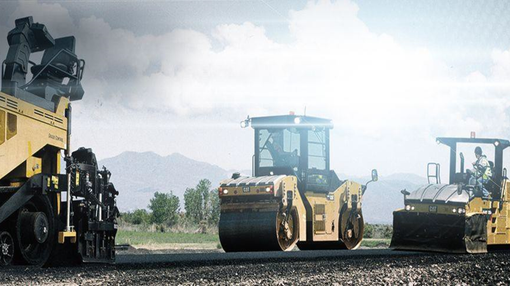
In the study Connecting the dots: Task-oriented Virtual Reality for the training of situational awareness in secondary vocational engineering education, I developed a Virtual Reality training programme in which Situation Awareness of vocational engineering students focusing on road construction is trained and assessed. Also see: https://www.utwente.nl/en/connectingthedots/
Publications
2026
2025
2024
Research profiles
I am a teacher in various courses of the MSc Educational Science & Technology programme as well as the accompanying premaster's programme. My focus is on the teaching of academic skills such as writing academic articles, which is central in both the course Academic writing and the course Research Studio in the premaster's programme. I also supervise thesis students with projects that align with my research interests.
I am a member of the Programme Committee EST, which is an advisory board for the programme director and has to be heard regarding all educational matters.
Affiliated study programs
Courses academic year 2026/2027
Courses in the current academic year are added at the moment they are finalised in the Osiris system. Therefore it is possible that the list is not yet complete for the whole academic year.
Courses academic year 2025/2026
Current projects

AI and Data (AID) literacy for teachers and students
The use of data and AI to improve education and learning requires data and AI literacy of teachers and students. For the current generation of teachers and students, there is still room for improvement when it comes to both forms of literacy. Currently, every institution and sometimes even every programme is setting its own course when it comes to developing these competencies. We will jointly develop a national framework, collect practical examples and devise professionalization interventions for students and develop teachers that help them function successfully in a society in which data and algorithms will play an increasingly important role.
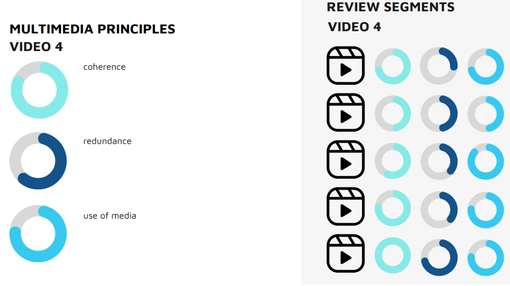
HAI-FIVE: High-quality AI-Feedback on Instructional explanation Videos for Education
In this project, we are developing an AI tool that provides pre-service teachers with feedback on microlectures. In the study, we collect data about the effectiveness, as well as perceptions and reflections of students.
Facilitating AI literacy in secondary school teachers with professional learning communities
In this project, professional learning communities are set up that are designed to facilitate AI literacy of secondary school teachers. The study targets the effectiveness and processes through which AI literacy in participants is facilitated.

FORCE AI
Fostering Opportunities, Resources, and Capabilities in AI for Effective Management of Higher Education Institutions
FORCE AI is a European initiative dedicated to unlocking the full potential of Artificial Intelligence in Higher Education. While AI is already enhancing teaching and learning, its true power lies in transforming the entire institution – from administration to student support. FORCE AI addresses this opportunity by empowering universities with the knowledge, tools, and professionals needed to lead AI integration strategically and responsibly.
Finished projects
Address
University of Twente
Capitool 15 (building no. 78), room 318
Capitool 15
7521 PL Enschede
Netherlands
University of Twente
Capitool 15 318
P.O. Box 217
7500 AE Enschede
Netherlands
 Scan the QR code or