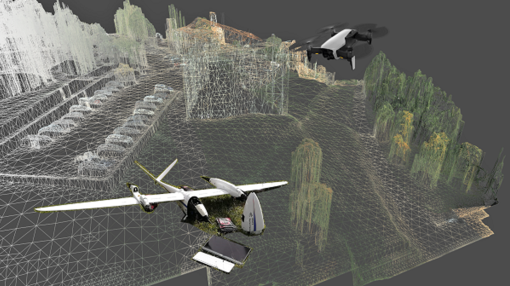
Existing UAV tech struggles with real-time 3D mapping for disaster relief. We propose new algorithms to create these maps faster, combining photogrammetry and deep learning for better emergency response.

**Talks about System Modeling and Control, Robotics (Mobile Robots), System ID, Deep Computer Vision, Photogrammetry, and Reinforcement Learning.

Expertise

  • Computer Science

    • Unmanned Aerial Vehicle
    • Zero-Shot Learning
    • Annotation
    • Depth Estimation
    • Point Cloud
    • Probabilistic Inference
    • Feature Extraction
    • Time Processing

Organisations

Other contributions

ZeD-MAP: Bundle Adjustment Guided Zero-Shot Depth Maps for Real-Time Aerial Imaging
Real-time depth reconstruction from ultra-high-resolution UAV imagery is essential for time-critical geospatial tasks such as disaster response, yet remains challenging due to wide-baseline parallax, large image sizes, low-texture or specular surfaces, occlusions, and strict computational constraints. Recent zero-shot diffusion models offer fast per-image dense predictions without task-specific retraining, and require fewer labelled datasets than transformer-based predictors while avoiding the rigid capture geometry requirement of classical multi-view stereo. However, their probabilistic inference prevents reliable metric accuracy and temporal consistency across sequential frames and overlapping tiles. We present ZeD-MAP, a cluster-level framework that converts a test-time diffusion depth model into a metrically consistent, SLAM-like mapping pipeline by integrating incremental cluster-based bundle adjustment (BA). Streamed UAV frames are grouped into overlapping clusters; periodic BA produces metrically consistent poses and sparse 3D tie-points, which are reprojected into selected frames and used as metric guidance for diffusion-based depth estimation. Validation on ground-marker flights captured at approximately 50 m altitude (GSD is approximately 0.85 cm/px, corresponding to 2,650 square meters ground coverage per frame) with the DLR Modular Aerial Camera System (MACS) shows that our method achieves sub-meter accuracy, with approximately 0.87 m error in the horizontal (XY) plane and 0.12 m in the vertical (Z) direction, while maintaining per-image runtimes between 1.47 and 4.91 seconds. Results are subject to minor noise from manual point-cloud annotation. These findings show that BA-based metric guidance provides consistency comparable to classical photogrammetric methods while significantly accelerating processing, enabling real-time 3D map generation.

Real-Time Bundle Adjustment for Ultra-High-Resolution UAV Imagery Using Adaptive Patch-Based Feature Tracking
Real-time processing of UAV imagery is crucial for applications requiring urgent geospatial information, such as disaster response, where rapid decision-making and accurate spatial data are essential. However, processing high-resolution imagery in real time presents significant challenges due to the computational demands of feature extraction, matching, and bundle adjustment (BA). Conventional BA methods either downsample images, sacrificing important details, or require extensive processing time, making them unsuitable for time-critical missions. To overcome these limitations, we propose a novel real-time BA framework that operates directly on fullresolution UAV imagery without downsampling. Our lightweight, onboard-compatible approach divides each image into user-defined patches (e.g., NxN grids, default 150x150 pixels) and dynamically tracks them across frames using UAV GNSS/IMU data and a coarse, globally available digital surface model (DSM). This ensures spatial consistency for robust feature extraction and matching between patches. Overlapping relationships between images are determined in real time using UAV navigation system, enabling the rapid selection of relevant neighbouring images for localized BA. By limiting optimization to a sliding cluster of overlapping images, including those from adjacent flight strips, the method achieves real-time performance while preserving the accuracy of global BA. The proposed algorithm is designed for seamless integration into the DLR Modular Aerial Camera System (MACS), supporting largearea mapping in real time for disaster response, infrastructure monitoring, and coastal protection. Validation on MACS datasets with 50MP images demonstrates that the method maintains precise camera orientations and high-fidelity mapping across multiple strips, running full bundle adjustment in under 2 seconds without GPU acceleration.

Research profiles

Current projects

Real-Time 3D Semantic Mapping with UAV Images

Existing UAV tech struggles with real-time 3D mapping for disaster relief. We propose new algorithms to create these maps faster, combining photogrammetry and deep learning for better emergency response.

QR codeScan the QR code or
Download vCard