Venkatasubramanian Kalpathy Venkiteswaran is Assistant Professor in the Department of Biomechanical Engineering at University of Twente. He is working on smart devices for minimally invasive interventions and robotic surgery. His expertise is in design of small-sized interventional devices and the use of magnetic fields to control them.
Previously, he was a postdoctoral research fellow at the Surgical Robotics Lab at University of Twente for two years. He received his doctoral degree in Mechanical Engineering from The Ohio State University, USA, working on design principles for compliant mechanisms.
Expertise
Engineering
- Actuation
- Robotics
- Manipulator
- Rigidity
- Soft Robot
- Magnetic Field
Material Science
- Shape Memory Polymer
- Polymer
Organisations
My research focuses applying mechanical design principles to develop novel devices for minimally invasive interventions and robotic surgery. In particular, I focus on exploiting flexibility and softness in materials and structures for new solutions to medical problems. These attributes are combined with 'smart materials' which include magnetic response, shape memory behaviour, and enzymatic response. I utilize these combinations to engineer small-sized medical devices and open up new possibilities for medical interventions.
I am currently active in three lines of research:
- laparoscopic and robotic surgery tools with enhanced dexterity and in-body access
- soft robotic devices using magnetic fields for targeted interventions
- tracking and localization of these devices using ultrasound or other sensors
Publications
2026
2025
2024
Research profiles
Courses academic year 2026/2027
Courses in the current academic year are added at the moment they are finalised in the Osiris system. Therefore it is possible that the list is not yet complete for the whole academic year.
Courses academic year 2025/2026
Current projects
FlexSMART: Flexible, Smart, Magnetic, Actively-controlled Robotic Tools for Minimally Invasive Surgery
Funded by NWO (Open Technology Programme)
FlexSMART proposes to create a new class of highly functional yet flexible surgical devices that work in tandem with robotic actuation units to broaden the scope of minimally invasive surgery. The project aims for the advancement of minimally invasive surgery through robotic technology, leading to new devices for the medical instrumentation market and improvements in infrastructure for hospitals. The technology developed through FlexSMART will be translated to surgical operating theaters with help from clinical and commercial partners involved in the project.
PRIMA: 4D PRInting of multifunctional smart Medical Actuators
Funded by ET Faculty (University of Twente)
Biomedical devices are routinely used within the human body, in the form of implants and as diagnostic or therapeutic tools. Typically, these devices are designed for passive implantation and cannot be actively controlled once inside the body. This leads to medical complications in case of unforeseen circumstances, necessitating additional surgical procedures and causing distress for the patient. Some medical devices require battery sources and other components, making them bulky and prone to maintenance issues. The limited design and manufacturing options also mean that clinicians must choose from a small range of options, and personalizing devices to specific patient needs is prohibitively expensive.
To overcome these limitations, the PRIMA project proposes the development of a manufacturing approach for novel medical devices that can be effectively controlled from outside the patient's body using different stimuli. The utilization of 3D printing technology allows for the customization of medical devices tailored to case-specific and patient-specific requirements. This project will involve close collaboration among the Advanced Manufacturing, Sustainable Products & Energy Systems (AMSPES), Surgical Robotics (SR), and Thermal Engineering (TE) groups within the Faculty of Engineering (ET) at the University of Twente.
Finished projects

Symbiobot: Shape-Morphing Bioinspired Origami Soft Robot for Minimally Invasive Surgery
Funded by ET Faculty (University of Twente)
Minimally invasive surgery (MIS) and computer-assisted robotic surgical tools have significantly improved the outcomes of surgical interventions from the perspective of patient health. In spite of these fantastic developments, there are technological bottlenecks on the types of instruments that can be developed and procedures that can be targeted, because the surgical tool is always mechanically attached to an external control console. We propose to eliminate this tether, and open a new chapter in MIS, whereby an untethered bot with unencumbered dexterity can perform hitherto impossible tasks (e.g., targeted drug delivery to stop a hemorrhage in deep-seated organs such as the heart or small intestine). Actuation using magnetic fields makes this possible, while being human-safe and also improving controllability for miniaturized bots. Through origami-inspired design, these miniaturized bots can morph shapes depending on the phase of the surgical procedure.
FlexMi (Flexure-Based Miniaturized Robots for Surgical Applications)
Funded by ET Faculty (University of Twente)
FlexMi proposes to establish a model-based design methodology to develop a new class of flexure-based robotic devices that work in tandem with remote magnetic actuation systems to broaden the scope of minimally invasive surgery. Millimetre-scale flexure-based components will be developed on the basis of computationally-efficient models for reliable actuation response over a large range of motion. Magnetic actuation will be used for instantaneous and accurate mechanical load transfer without the needs for cables or wires. The remote sensing capabilities of flexures and magnetic components will aid with miniaturization. FlexMi works towards magnetic and flexure-based smart robots to support surgeons to reach difficult-to-access areas within the human body.
MADSC : Magnetically-actuated Deployable Stent Catheter for Percutaneous Coronary Interventions
Funded by Pioneers in HealthCare Innovation Fund
Coronary heart disease is the leading cause of death in the world, and this project aims to improve the treatment of this ailment through the development of a novel catheter system using magnetic actuation. The actuation will be achieved using a computer-assisted Remote Magnetic Navigation (RMN) system, and will improve control over catheter steering, thereby reducing damage to blood vessels, and will decrease radiation exposure compared to prevalent fluoroscopic guiding techniques. Improved surgical efficiency and reduced hospitalization times will mean better utilization of medical resources and personnel, and superior quality of life for patients.
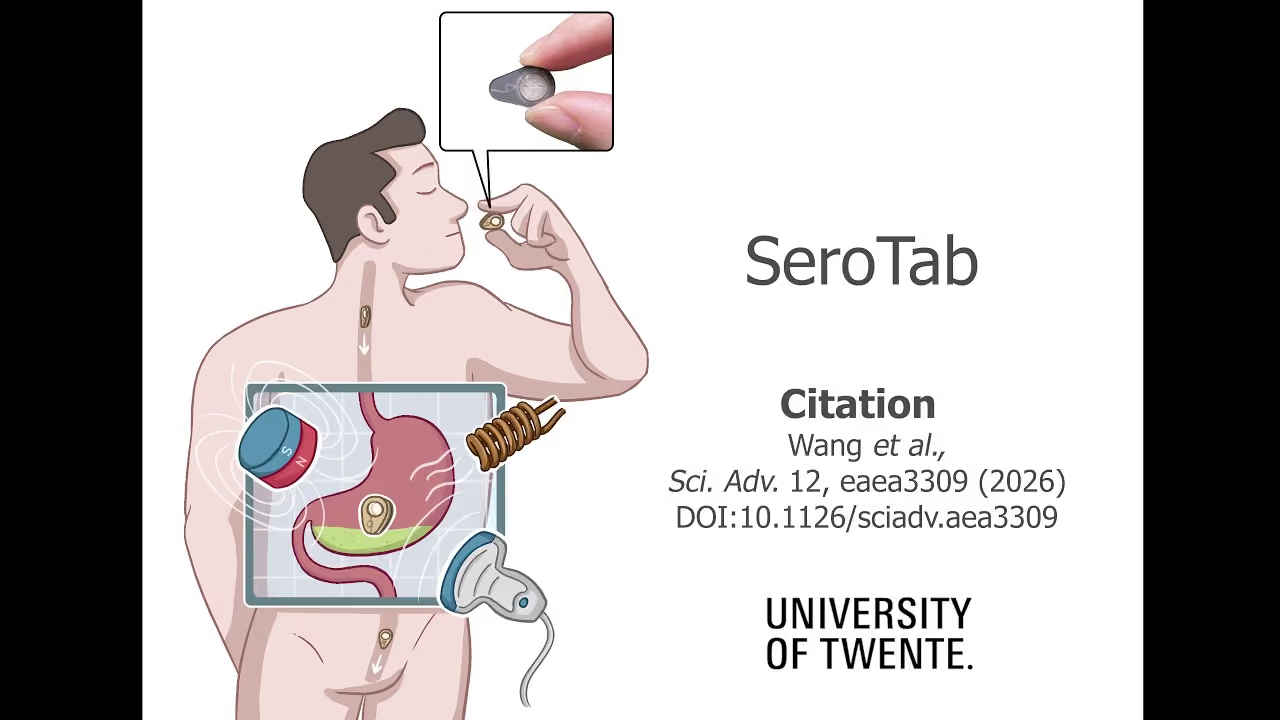
SeroTab
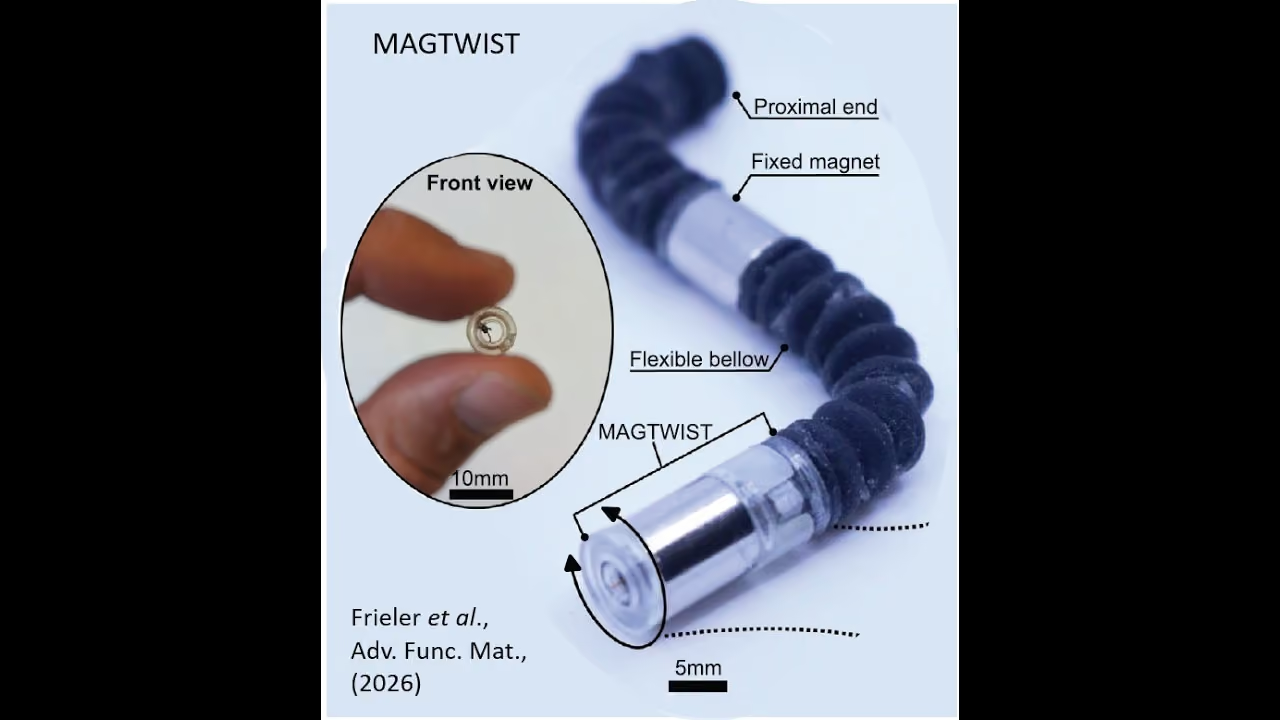
MAGTWIST
In the press
Soft Robotic Capsules highlighted in local and national media:
Magnetic programmable materials featured at Dutch Design Week 2024
Related workshop: https://www.4tu.nl/du/projects/Expressive-Mechanisms/
Address

University of Twente
Horst Complex (building no. 20), room W102
De Horst 2
7522 LW Enschede
Netherlands
University of Twente
Horst Complex W102
P.O. Box 217
7500 AE Enschede
Netherlands
 Scan the QR code or